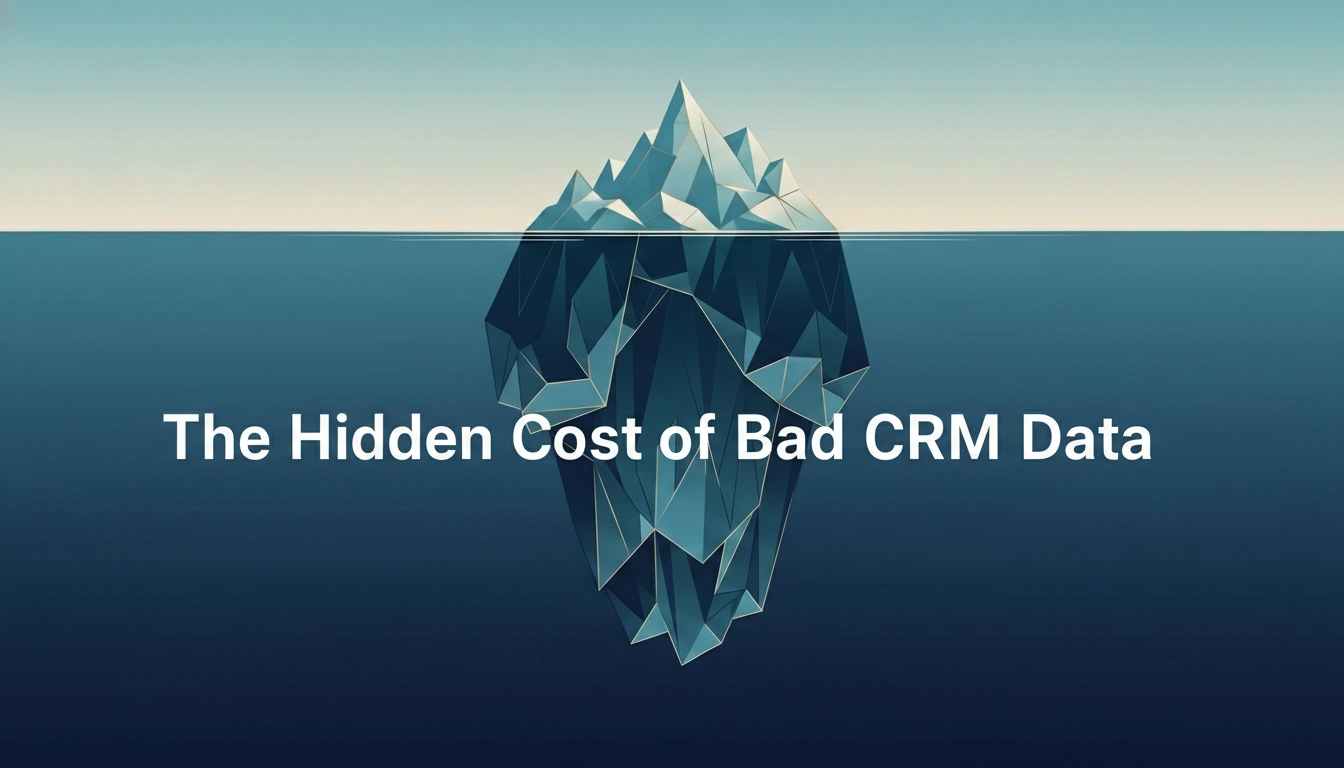
Your CRM was supposed to be the single source of truth for your business. A central place where everyone could see customer information, track deals, and make better decisions.
Instead, your sales team doesn't trust it. Marketing complains the data is useless. And when someone asks a simple question like "how many active customers do we have?" - you get three different answers depending on who you ask.
The problem isn't the software. It's the data inside it.
Bad CRM data is one of those problems that starts small and grows quietly. A few duplicate records here. Some outdated contact information there. Before you know it, you're making decisions based on information that's incomplete, inaccurate, or just plain wrong.
And it's costing you more than you realize.
What Is Bad CRM Data?
Before we talk about costs, let's be clear about what we mean by "bad" data. It's not just obviously wrong information. Bad CRM data includes:
- Inaccurate data - Contact details that are wrong. Job titles that have changed. Company information that's out of date.
- Incomplete data - Records missing critical fields. Customer profiles with gaps. Deals without key details filled in.
- Duplicate data - The same customer appearing multiple times. Contacts entered by different people in different ways.
- Outdated data - Information that was correct once but isn't anymore. Old addresses, former employees, closed companies.
- Inconsistent data - "IBM" in one record, "International Business Machines" in another. "United States" here, "USA" there, "US" somewhere else.
Here's a sobering statistic: research shows that roughly 70% of contact data has at least one change within 12 months. People change jobs. Companies relocate. Phone numbers and email addresses get updated. If you're not actively maintaining your data, it's decaying faster than you think - about 2% per month, or over 20% per year.
The Obvious Costs
Some costs of bad data are easy to see:
- Bounced emails and failed campaigns. When 10% of your email list bounces, you're not just wasting that send - you're hurting your sender reputation and reducing deliverability for everyone else on the list.
- Wasted sales time. Your reps spend time chasing leads that went cold months ago, calling numbers that no longer work, or reaching out to people who left the company. That's time they could spend on real opportunities.
- Duplicate outreach. Nothing damages credibility faster than having two different salespeople contact the same prospect within days of each other - or worse, the same day.
The Hidden Costs
The bigger costs are the ones you can't easily see on a report. They accumulate quietly and compound over time.
Lost Deals You Never Knew About
When your data is unreliable, your team stops using the CRM the way it was intended. They keep their own spreadsheets. They rely on memory. Critical information about customer preferences, past conversations, and buying signals never makes it into the system - or gets lost in the noise.
Deals slip through the cracks. Follow-ups don't happen. Opportunities that should have been obvious get missed entirely.
You can't measure deals you never knew you lost.
Decisions Based on Bad Information
When leadership looks at the CRM for forecasting, pipeline reports, or strategic planning, they're making decisions based on whatever data is in the system. If that data is incomplete or inaccurate, those decisions are built on a faulty foundation.
Research indicates that poor data quality costs organizations an average of $12.9 million annually. That figure includes lost opportunities, operational inefficiencies, and rework - but the real cost to any individual business depends on how heavily they rely on their CRM data for decisions.
Eroded Trust in the System
This might be the most damaging hidden cost: when people stop trusting the CRM, they stop using it properly. And when they stop using it properly, data quality gets even worse. It's a downward spiral.
Customer Experience Failures
Bad data doesn't just affect internal operations - it shows up in how you interact with customers. Calling a customer by the wrong name. Sending them information about products they already own. Having no record of a conversation they had with your team last week.
Wasted Marketing Spend
When your customer data is unreliable, your marketing targeting suffers. You end up spending money reaching the wrong people, or reaching the right people with the wrong message.
Signs You Have a Data Problem
- Your team doesn't trust the CRM. If people routinely question the accuracy of reports.
- Reports from different sources don't match. When marketing's customer count doesn't match sales or finance.
- You have obvious duplicates. If you can find duplicate records with a basic search.
- Key fields are frequently empty. Critical data points are missing from a significant percentage of records.
- People complain about data entry. Resistance to entering data is often a symptom, not a cause.
- You can't answer basic questions easily. How many customers did we acquire last quarter? What's our average deal size?
What You Can Do About It
Understand the Current State
Before you can fix the problem, you need to understand how bad it actually is. Audit your data quality: What percentage of records are complete? How many duplicates exist?
Fix the Process, Not Just the Data
Cleaning up existing data is important, but it's temporary if the processes that created the mess are still in place. Look at how data enters your system.
Make It Easy to Do the Right Thing
If your CRM is difficult to use, people will find workarounds. Good data quality requires systems that work the way people actually work.
Build Accountability
Assign clear ownership for data standards, regular audits, and ongoing maintenance.
How Bad Data Shows Up Across Industries
- Automotive Retail: Sales teams resist CRM adoption, so lead sources go untracked. → Automotive Retail Consulting
- Hospitality & Gaming: Guest profiles fragment across reservation systems and loyalty platforms. → Hospitality & Gaming Consulting
- Retail & E-commerce: The customer who browses online and buys in-store appears as two separate people. → Retail & E-commerce Consulting
- Professional Services: Relationship history lives in partners' heads, not the CRM. → Professional Services Consulting
- Consumer Goods: Distributor and retailer data sits in spreadsheets or disconnected systems. → Consumer Goods Consulting
The Bottom Line
Bad CRM data isn't just a nuisance - it's a business problem that compounds over time. It wastes resources, undermines decisions, damages customer relationships, and erodes the value of your CRM investment.
Your CRM is only as valuable as the data inside it.
Key Takeaways
- CRM data decays faster than you think - roughly 20% per year.
- The hidden costs exceed the obvious ones - lost deals, bad decisions, and eroded trust.
- Bad data creates a downward spiral of declining trust and use.
- Warning signs are often cultural (distrust of reports).
- Process matters more than cleanup.
Next Steps
If your CRM isn't delivering the value you expected - or if you recognize the warning signs of a data quality problem - it might be time for an outside perspective.
Our CRM Strategy practice helps businesses identify what's broken and build sustainable data processes. We've driven adoption from 45% to 97% by addressing the human and process elements.
FAQ
How much does bad CRM data actually cost?
Research from Gartner estimates poor data quality costs organizations an average of $12.9 million per year. Even for smaller organizations, the costs add up quickly.
How fast does CRM data go bad?
B2B contact data decays at roughly 2% per month - about 22% per year. This happens naturally as people change jobs and companies relocate.
Can't we just buy a tool to fix our data?
Tools can help with deduplication or data enrichment. But bad data is usually a symptom of process and adoption problems.
*Published by EncubIQ Consulting | Last Updated: February 2026*